
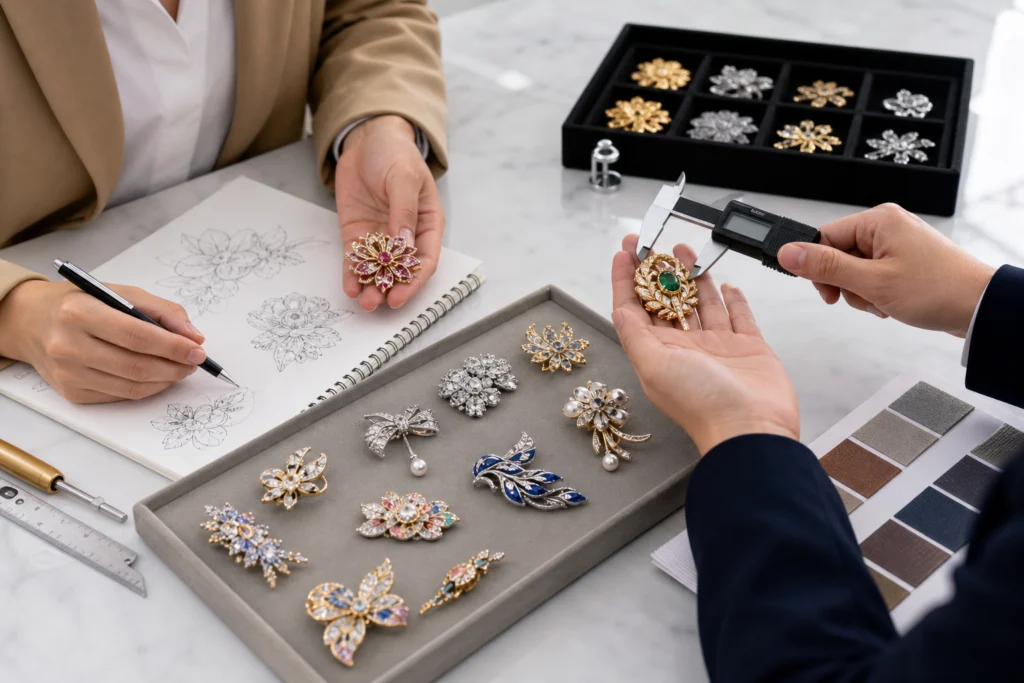
What should a procurement team verify before selecting a wholesale custom brooches manufacturer? Start with the information that changes the delivered product: material construction, dimensions, finish, fastening, artwork, packaging, and the approval process. A visually appealing reference image is not a production specification. Without written decisions on these points, buyers may receive a brooch that is broadly similar to the concept but unsuitable for the intended retail, promotional, or souvenir program.
Brooch sourcing involves more than the decorative front piece. The reverse side, pin mechanism, attachment method, weight, sharp edges, plating coverage, and pack-out can all affect usability, presentation, and import readiness. Treat the supplier evaluation as a controlled translation of a design brief into repeatable manufacturing requirements.
Which product specifications must the supplier be able to address?
A capable supplier should be able to discuss the requested design in production terms, identify open decisions, and record the approved requirements. For custom projects, provide a dimensioned drawing where possible. If the project begins with a photograph, sketch, or inspiration link, expect a separate review to establish measurable details before production approval.
Define the material and decorative construction
Specify the base material rather than relying on terms such as “metal brooch.” Common fashion-accessory options can include zinc alloy, copper, iron, stainless steel, acrylic, resin, natural stone, and 925 sterling silver, but the correct selection depends on the design, target price, required finish, and market requirements. Ask the supplier to identify the proposed material for each major component: body, pin, clutch or locking element, stones, enamel area, and decorative inserts.
Also distinguish among decoration types. Plating is a surface finish, not the base metal. Enamel, resin, printed artwork, rhinestones, or stone inserts each introduce different color, adhesion, assembly, and inspection considerations. A written specification should state the intended look and the acceptable variation range where color or hand-applied details are involved.
YUNGSHANG’s brooch page describes custom brooch support involving plating, enamel, resin, and packaging for wholesale buyers. Its broader product information asks buyers to submit photos, drawings, or reference links along with target material and finish. Those are useful starting inputs, but they should be converted into an approved specification for the individual order.
Control dimensions, function, and wearability
State overall length, width, thickness, and, when relevant, pin length and usable opening. Tolerances should be agreed for dimensions that affect cards, boxes, display fixtures, or garment placement. For multi-piece or articulated brooches, identify the assembly layout and movement requirements.
The fastening deserves its own line item. Specify the pin style, safety catch or other closure type, orientation, number of attachment points, and whether the brooch must sit level on a particular fabric weight. Ask how the supplier will evaluate closure operation, pin alignment, attachment security, and visible sharpness. These are functional acceptance points, not cosmetic preferences.
Make the artwork production-ready
Supply vector artwork, logo files, font details, color references, and placement instructions when branding is required. Confirm whether artwork is raised, recessed, filled, engraved, printed, or represented through an applied element. Tiny text and narrow lines may not reproduce consistently at brooch scale; the supplier should flag these risks before sample approval.
- Front and back views, with dimensions in a stated unit
- Base material and each decorative material
- Finish or plating color, plus any antique, matte, polished, or textured effect
- Color references for enamel, resin, printing, and stones
- Pin and closure configuration
- Logo, artwork, and required placement
- Individual weight target if freight, card strength, or wearability depends on it
- Packaging format, labels, barcodes, and SKU requirements
- Target market and any buyer-defined compliance requirements
For programs that combine brooches with other accessories, align these data fields across categories. The same discipline applies to a custom pendant sourcing review: a material name alone is not enough to define the final item.
Which samples, inspection records, or documented processes support evaluation?
The pre-production sample is the main decision point for a custom brooch. It should be assessed against the approved drawing, material proposal, finish, colors, fastening, logo, packaging, and any required labels. Keep the approved sample or a clearly documented approval record as the reference for bulk production. A verbal “looks good” leaves too much room for interpretation.
Review samples for both appearance and function
Inspect the front and reverse side under normal viewing conditions. Check the proportion of raised details, color boundaries, surface consistency, stone or decorative-element placement, and symmetry. Then operate the closure repeatedly and examine the connection between the pin assembly and the brooch body. A design can pass a visual review yet fail the practical test of attaching securely to the intended garment or display card.
Where packaging is part of the customer experience, review a packed sample. Confirm that the brooch stays in position, the pin does not puncture the pack, labels are legible, and the selected pack protects decorative surfaces during ordinary handling. Packaging should be approved as part of the product configuration, not added after the bulk sample is signed off.
Request records that correspond to the order
Ask what documentation the supplier can provide for the specific project and at which stage. Useful records may include the approved specification, sample approval record, in-process inspection checkpoints, final inspection results, packing list, and shipment documents. The form and level of detail should be agreed in the purchase order or quality agreement.
YUNGSHANG states that its process includes pre-production sample approval, final inspection, packing-detail review, and shipping documents before dispatch. The company also refers to sample confirmation, in-process inspection, packaging checks, and selected component test-report references. Buyers should request the actual records relevant to their order rather than treating a general process description as proof that every lot has been inspected or tested.
The site further states that selected jewelry component samples have passed lead, cadmium, and nickel-release testing, while explicitly limiting those claims to the tested samples. This does not demonstrate compliance for a different brooch design, material combination, production batch, or destination market. If testing is required, define the applicable requirement, test scope, sample selection, laboratory expectations, responsibility for cost, and document delivery before production begins.
What should be confirmed before requesting a quote or placing an order?
A quote is only comparable when suppliers are pricing the same configuration. Send the product category, reference images or drawings, material, size, finish or color, quantity, logo request, packaging method, and target market. YUNGSHANG lists these inputs for quotation and asks buyers to include quantity, packaging, and compliance needs; this is a sensible RFQ baseline for custom brooches.
Separate quote assumptions from approved commitments
Before issuing a purchase order, convert assumptions into written terms. Confirm the unit of quotation, product configuration, tooling or development charges if applicable, sample arrangement, approved artwork revision, packaging, inspection arrangement, delivery point, shipping responsibility, payment terms, and the process for handling nonconforming goods. Do not infer lead time or minimum order quantity from a product page; request them in the supplier’s written quotation for the stated design and quantity.
- Issue one controlled RFQ package with drawings, artwork, material, finish, fastening, packaging, quantity, and destination.
- Review the supplier’s proposal for omissions, substitutions, and production questions.
- Approve a sample and document every approved feature, including the reverse side and pack-out.
- Set inspection and acceptance requirements before bulk production, including any required testing scope.
- Place the order only after the quotation, approved sample reference, and purchase-order terms describe the same configuration.
The best supplier choice is not necessarily the one with the lowest initial quote. It is the one whose proposal makes the product definition, approval path, evidence, and responsibilities clear enough for the buyer to manage risk.
Frequently Asked Questions
What should be included in an RFQ for custom wholesale brooches?
Include reference images or a dimensioned drawing, base and decorative materials, size, finish or plating, colors, pin and closure type, logo or artwork files, quantity, packaging, labeling, target market, and any required compliance or testing scope. Ask the supplier to identify any assumptions in writing.
Is a pre-production sample necessary for a custom brooch order?
For a custom design, a pre-production sample is a practical control point because it allows the buyer to approve appearance, construction, fastening, artwork, and packaging before bulk production. Keep the approval record or approved sample as the production reference.
Do component test reports prove that all brooches meet market requirements?
No. A report supports only the tested sample, stated method, and scope. It does not automatically apply to another brooch design, material combination, production batch, or market. Define required testing and documentation for the specific order.
Why does the brooch fastening need to appear in the specification?
The fastening affects attachment security, orientation, usability, and the risk of damage to packaging or garments. Specify the pin style, closure type, placement, number of attachment points, and relevant functional acceptance criteria.