
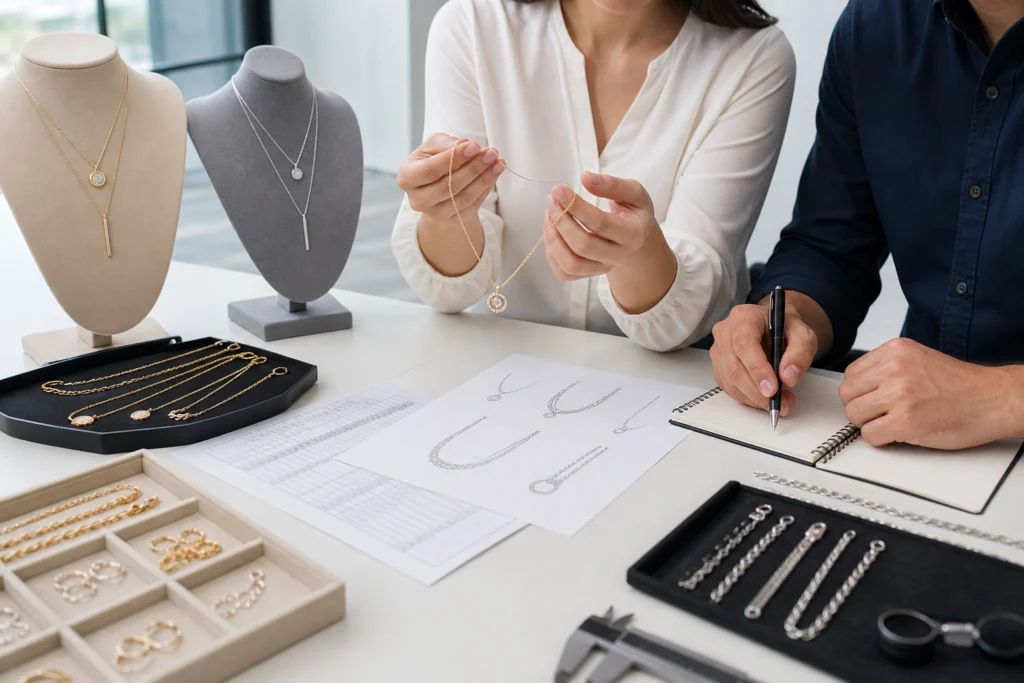
What must a wholesale custom necklaces manufacturer prove before a buyer commits to a production order? The answer is not simply that the supplier can show attractive necklace styles. Procurement needs to establish whether the supplier can translate a defined product brief into repeatable production, document agreed requirements, and provide evidence at the sample and inspection stages.
Necklace programs create several avoidable risks: an approved pendant paired with the wrong chain length, a finish that differs from the reference sample, a clasp that does not match the intended use, or retail packaging that fails to carry the required barcode or label. A disciplined evaluation separates design appeal from production readiness.
Start with the necklace type and commercial use case
“Necklace” is too broad to serve as a manufacturing specification. A supplier may handle pendant necklaces, chokers, collarbone chains, sweater chains, layered designs, bead necklaces, or cord necklaces, but each format brings different component, assembly, and packing considerations. Define the intended retail position and wearer use before discussing a quote.
For example, a short choker requires a controlled finished length and closure arrangement. A layered necklace needs defined lengths for every strand, along with rules for spacing and tangling. A pendant necklace needs clear information on pendant dimensions, jump rings, bail construction, chain type, and pendant orientation. These are product requirements, not minor production details.
Which product specifications must the supplier be able to address?
A capable evaluation begins with a written specification package. Photos can communicate a visual direction, but they rarely resolve the dimensions, tolerances, finishes, and component choices needed for consistent wholesale production. Send a drawing when available; otherwise, build a structured brief around an approved reference.
Material and finish definition
State the intended base material rather than using a visual description such as “gold necklace.” The material may affect weight, forming methods, component compatibility, cost, and testing strategy. Common fashion-jewelry material options can include zinc alloy, copper, iron, stainless steel, 925 sterling silver, natural stone, acrylic, and resin. The appropriate choice depends on the product construction and commercial brief; it should not be assumed from a product photograph.
Specify finish in measurable terms where possible: color reference, plating or coating description, polished versus matte appearance, stone or bead color, and any intentional antiqued effect. If a finish must match another item in a collection, provide the approved comparison sample or color standard. Product names that use terms such as “18K gold” or “white gold plated” are not substitutes for a production specification.
Dimensions, construction, and components
- Finished necklace length, including whether the extension chain is included in the measurement.
- Extension-chain range and the exact clasp type.
- Chain style, link dimensions, wire or material gauge where relevant, and pendant attachment method.
- Pendant, charm, bead, stone, or resin-component dimensions and permitted variation.
- Number and sequence of strands, beads, charms, or links for layered and beaded designs.
- Logo location, logo method, artwork version, and minimum readable mark size.
- Required functional details, such as an articulated pendant, movable elements, or a fixed front-facing orientation.
Ask the supplier to identify any feature that cannot be controlled from the supplied brief. This matters particularly where handmade assembly, natural stone, resin effects, or mixed-material components may introduce visible variation. The goal is not to eliminate all variation; it is to establish which variation is acceptable before mass production.
Packaging and destination requirements
Packaging should be part of the product specification, not an afterthought. Define the necklace card, pouch, box, polybag, anti-tarnish requirement if applicable, barcode or SKU label, hang tag, carton mark, and pack quantity. Packaging must also protect the necklace from scratches, tangling, deformation, or component loss during transit.
For US-bound orders, the importer should provide its required labeling, packaging, and compliance instructions. A manufacturer can support the agreed process, but the buyer should not infer legal suitability from a general product description or from an isolated test document.
Which samples, inspection records, or documented processes support evaluation?
The strongest practical evidence is an approved sample tied to a controlled written specification. Before bulk production, compare the sample with the brief for finished length, component selection, finish, assembly, logo, and packaging. Record the approval date, artwork revision, and any deviations accepted by the buyer. A verbal approval creates ambiguity when production questions arise later.
Request clarity on the supplier’s documented checkpoints. Useful records may include a sample approval record, material or component confirmation, in-process inspection notes, final inspection results, packing check records, and shipping documents. The buyer should agree in advance which checkpoints apply and what information the supplier will provide.
| Evaluation evidence | What it should confirm | Buyer follow-up |
|---|---|---|
| Pre-production sample | Appearance, dimensions, components, construction, and approved finish | Approve or reject against the written specification |
| In-process inspection record | Whether agreed production checks occurred during assembly or finishing | Confirm checkpoints and any corrective-action process before ordering |
| Final inspection record | Agreed checks on appearance, count, assembly, and packing condition | Define acceptance criteria and report format in advance |
| Component test reference | The result for the named sample or component under the stated test | Check sample identity, scope, date, method, and relevance to the order |
Testing evidence requires especially careful reading. A test result for a selected component sample does not establish that every material, finish, or future production lot meets the same requirement. It also does not replace the buyer’s responsibility to determine which requirements apply in the destination market. If a claim depends on a particular material or component, request evidence that identifies that item and discuss whether additional testing is needed for the ordered configuration.
YUNGSHANG’s product information states that it supports OEM and ODM jewelry development and asks buyers to submit photos, drawings, or reference links along with target material and finish. Its site also describes sample review, in-process inspection, packaging checks, and selected component test-report references. The product page states that selected jewelry component samples have passed lead, cadmium, and nickel-release testing, while expressly limiting those claims to the tested samples. Buyers should therefore request the applicable underlying records and verify their scope against the proposed necklace specification.
What should be confirmed before requesting a quote or placing an order?
An RFQ is most useful when it asks for a quote against a stable, reviewable brief. Send the product category, design files or reference images, material, finish, dimensions, quantity, logo request, packaging method, destination market, and requested delivery terms. If information is undecided, label it as an option rather than leaving it implicit.
Quote-stage confirmations
- Confirm the exact item configuration being priced, including chain, pendant, finish, clasp, logo, and packaging.
- State the quantity by SKU, color, length, or finish; mixed assortment quantities should be explicit.
- Identify tooling, mold, artwork, sampling, and revision assumptions separately where applicable.
- Agree the sample-approval route and whether production may begin only after written approval.
- Define inspection criteria, defect handling, packing method, and shipment documentation requirements.
- Confirm which party is responsible for destination-market compliance assessment, testing instructions, and required labels.
Before issuing a purchase order, attach the final approved specification, approved sample reference, current artwork, packaging artwork, inspection standard, and commercial terms. Revision control is essential: a necklace order can change materially when a clasp, plating tone, chain length, or card design changes. Each revision should carry a date or version identifier.
Using supplier website information appropriately
A supplier’s online range can help buyers determine whether a product category is relevant to an inquiry. YUNGSHANG’s necklace page lists collarbone chains, chokers, sweater chains, pendant necklaces, and layered necklaces, while its broader product page asks buyers to provide material, size, color or plating, quantity, logo, packaging, and target-market details for a quotation. That is useful starting information for an RFQ, not evidence that every style, material, or requirement is available for every order.
For a wholesale custom necklaces manufacturer, the buying decision should rest on the final technical brief, sample approval, documented checks, and order-specific commercial confirmation. Those controls give procurement teams a defensible basis for comparing suppliers and reducing preventable production disputes.
Related resources
Frequently Asked Questions
What should I send to a wholesale custom necklaces manufacturer for an accurate quote?
Send a product photo, drawing, or reference link; necklace type; target material; finish or color; finished dimensions; quantity by SKU; logo artwork; packaging requirements; and destination-market instructions. Include any required sample, inspection, labeling, or testing expectations.
What necklace dimensions should be specified?
At minimum, specify finished length, extension-chain range, pendant or charm dimensions, chain style, clasp type, strand lengths for layered designs, and the measurement method. State whether tolerances are required and identify dimensions that are critical to fit or appearance.
Does a component test report prove that the complete necklace complies with all requirements?
No. A component test report applies only to the identified sample, material, and test scope. It does not automatically cover different components, finishes, production lots, or all destination-market obligations. Review the report’s identity, date, method, and scope against the ordered necklace.
When should a buyer approve the necklace sample?
Approve the pre-production sample after checking it against the final written specification, including construction, material, finish, size, logo, and packaging. Record approval in writing and ensure that the approved sample and its revision are referenced in the purchase-order documentation.