
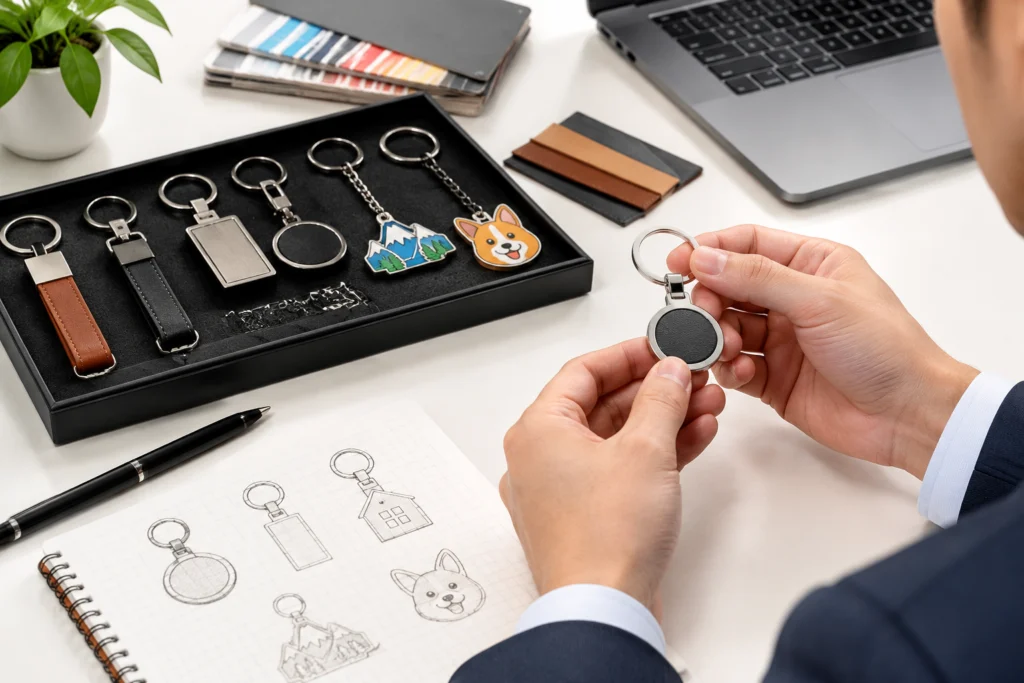
What should a procurement team verify before selecting a custom keychains wholesale manufacturer? Start with the physical specification and approval process, not the appearance of a product photo. A keychain may be intended for a souvenir shop, a promotional campaign, brand merchandise, or a retail collection, but each use case creates different demands for materials, attachment hardware, finish, packaging, labeling, and order controls.
The supplier’s role is not simply to reproduce an image. It is to convert the buyer’s concept into a written, inspectable product definition. That definition should remain consistent from quotation through sample approval, bulk production, packing, and shipment documentation.
Which Product Specifications Must the Supplier Be Able to Address?
A usable request for quotation defines more than a shape and logo. It identifies the version of the product that the supplier is being asked to price. If details are still open, list them as decisions pending rather than leaving them implicit.
Design and construction
Provide artwork, a technical drawing, reference photos, or a physical sample where available. Identify whether the design is one-sided or two-sided, flat or dimensional, and whether it includes moving, hanging, layered, or separate charm elements. For designs with small lettering, fine lines, or multiple colors, request that the supplier confirm how those details will translate at the proposed finished size.
Dimensions should state the decorated body size separately from the overall length with chain, ring, or other attachment. Include tolerances when fit or display consistency matters. A keychain designed for a compact retail card may need a different overall profile than one intended as a large promotional giveaway.
Material, finish, and color
Specify the intended base material, plating or surface finish, color treatment, and any non-metal components. General material options for custom accessory programs can include zinc alloy, copper, iron, stainless steel, acrylic, resin, natural stone, and sterling silver, but suitability depends on the design, target positioning, expected wear, and applicable requirements. Do not assume that a material mentioned in a supplier’s broader catalog is available for every keychain design.
State the finish in operational terms. For example, distinguish polished from antique effects, plated from painted surfaces, and transparent from opaque color areas. When a color must align with brand standards, provide approved digital values or physical references and define the acceptable matching method. Screen images alone are not a reliable approval standard for production color.
Hardware and functional details
The attachment is a product-critical component. Identify the requested ring, clasp, swivel, chain, split ring, or other hardware; its color; and whether the buyer has a preferred construction. For multi-piece designs, clarify which elements must move and which must remain fixed. Ask how the attachment joins to the decorative body, since that connection affects both appearance and functional review.
Also state the intended end use. A keychain used on a daily key set, a decorative bag charm, and a collectible souvenir may each justify a different construction and inspection emphasis. This is a design and sourcing discussion, not a substitute for defining product-specific safety or regulatory obligations in the destination market.
Branding, packaging, and market requirements
Logo placement, artwork version, hang tags, barcode labels, SKU labels, and retail packaging should be included in the specification package. A supplier may quote the keychain itself accurately while pricing packaging on different assumptions unless every component is stated. Define whether the unit needs an individual polybag, backing card, gift box, display-ready pack, inner carton arrangement, or master-carton mark.
YUNGSHANG’s product information asks buyers to provide product photos or drawings, material, size, color or plating, quantity, logo request, packaging method, and target market for a quotation. Its keychain category identifies custom keychains for promotional gifts, souvenirs, retail programs, and brand merchandise. Those are useful starting points for an RFQ, but buyers should still document the exact project requirements in writing.
Which Samples, Inspection Records, or Documented Processes Support Evaluation?
Evidence should match the order risk. A visual sample can establish general appearance, but it cannot by itself demonstrate that the approved design, hardware, packaging, and bulk order controls are aligned. Ask the supplier what evidence it can provide for the specific program, then make approval milestones part of the purchase documentation.
Samples that answer defined questions
A pre-production sample should be reviewed against a version-controlled specification. Check dimensions, artwork placement, finish, color, enamel or resin fill where applicable, sharp edges, assembly, attachment function, logo legibility, and packaging presentation. Record approvals and revisions in writing. If the approved sample differs from the final purchase-order specification, resolve the discrepancy before bulk production begins.
For a design with multiple variants, approve representative versions deliberately. A single sample may not verify every colorway, charm combination, or packaging configuration. Retain approved reference images and, where commercially appropriate, a physical sealed sample for comparison during final review.
Inspection and packing records
Ask which checks occur during production and before dispatch, who performs them, and how findings are recorded. Useful records may include approved sample sign-off, in-process inspection notes, final inspection records, count verification, packing lists, carton marks, and photo evidence of finished packing. The buyer should define acceptance criteria in advance, especially for cosmetic defects, missing components, mixed SKUs, and packaging errors.
YUNGSHANG states that its process includes sample confirmation, in-process inspection, packaging checks, and review of final inspection, packing details, and shipping documents before dispatch. This describes the supplier’s stated workflow, not independent proof of performance on every order. Request records tied to the actual purchase order and confirm what each review will cover.
Testing and compliance evidence
Testing needs are market- and product-specific. A buyer should identify applicable legal, retailer, importer, or customer requirements before requesting a quotation, then specify the required test scope, laboratory expectations, sample selection, report holder, and acceptable report date. A general statement about prior testing does not establish compliance for a new design, material combination, production lot, or destination.
YUNGSHANG states that selected jewelry component samples have passed lead, cadmium, and nickel-release testing, and explicitly limits that statement to tested samples. This should not be treated as evidence that a proposed keychain, all components, or a future production run meets any particular requirement. Obtain and assess documentation applicable to the ordered product where such evidence is required.
What Should Be Confirmed Before Requesting a Quote or Placing an Order?
Before requesting a quote, send one consolidated RFQ package rather than separate messages with changing assumptions. Include artwork or drawings, dimensions, material and finish, hardware, quantity by SKU, target market, logo requirements, packaging, labeling, requested delivery terms, and any testing or documentation needs. Ask the supplier to identify assumptions, exclusions, and items that remain subject to sample confirmation.
Before issuing a purchase order, reconcile the quotation, approved sample, artwork, packaging files, inspection criteria, and delivery terms. The written order should identify the product revision, quantities by variant, unit and total price, payment terms, production timing agreed by the parties, shipping arrangement, packaging configuration, required documents, and approval authority. Avoid relying on an informal photo approval when the order contains multiple finishes or SKUs.
For buyers evaluating YUNGSHANG, its published guidance directs prospects to share category, material, quantity, logo, and packaging requirements, and describes an approval sequence that includes a pre-production sample before bulk production. A productive inquiry should add the buyer’s complete specification and target-market requirements so the supplier can identify what must be confirmed for that particular keychain program.
The strongest supplier evaluation is therefore traceable: the quoted product is the sampled product, the sampled product is the inspected product, and the inspected product is the packed product. That continuity gives procurement teams a practical basis for comparing offers and managing approval risk.
Related resources
Frequently Asked Questions
What should be included in an RFQ for custom wholesale keychains?
Include artwork or drawings, finished dimensions, material, finish or plating, color requirements, hardware, quantity by SKU, logo details, packaging, labels, target market, delivery terms, and any required testing or documentation. Ask the supplier to state assumptions and exclusions in its quotation.
Is an approved sample enough to approve bulk keychain production?
An approved sample is an important reference, but it should be paired with a written specification, approved packaging files, defined inspection criteria, and order-specific production and packing controls. For multiple variants, confirm whether each colorway, configuration, and packaging format has been reviewed.
Can a supplier's previous component test statement prove a new keychain is compliant?
No. Evidence for selected tested component samples applies only to the named samples and test scope. A new keychain may use different materials, finishes, components, or production lots. Confirm the requirements for the destination market and obtain documentation applicable to the ordered product when required.
Why should packaging be specified before a wholesale keychain quote?
Packaging affects unit presentation, labeling, packing configuration, handling, and cost. Stating the individual pack, retail card or box, barcode or SKU labels, inner packs, and carton marks before quoting reduces the risk of mismatched assumptions.