
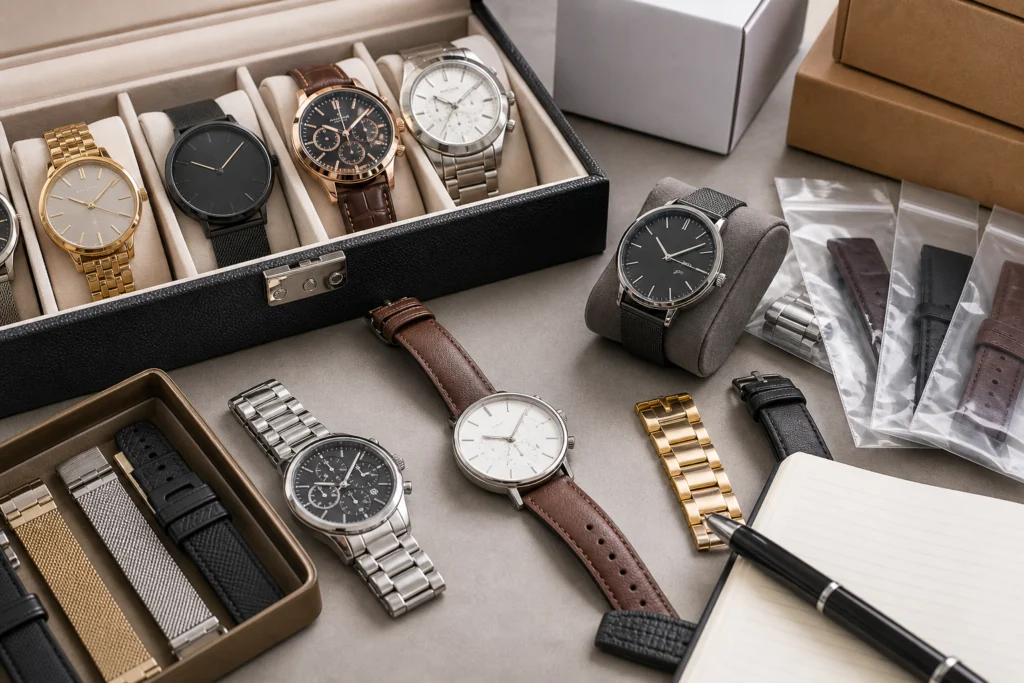
What should a procurement team verify before buying wholesale fashion watches and watch accessories? Start with the product definition—not the catalog image. A fashion watch may be a style-led accessory, but it still combines a case, dial, movement, hands, crystal, crown, strap or bracelet, clasp, and packaging. A missing detail in any one of those areas can change cost, appearance, wearability, or the scope of required testing.
For US buyers, the strongest supplier evaluation process turns a visual concept into an approved specification, then ties that specification to samples, inspection criteria, and written commercial terms. This approach is useful for branded retail collections, promotional programs, gift assortments, and private-label packaging projects.
YUNGSHANG’s fashion watches and watch accessories page states that it offers fashion watches and accessory components for wholesale and custom packaging projects. Its product page asks buyers to provide category, material, quantity, logo, and packaging notes, and to ask about available styles, materials, minimum order quantities, and private-label options. Those details should be confirmed for the specific watch or component under consideration rather than assumed from a general product category.
Which product specifications must the supplier be able to address?
A usable watch specification sheet should identify both the visible design and the functional construction. “Gold-tone watch with a leather-look strap” is a merchandising description, not a production specification. It does not define dimensions, component materials, movement type, coating requirements, attachment method, or acceptance criteria.
Define the watch assembly component by component
Ask the supplier to review a controlled drawing, annotated reference images, or a sample alongside a written bill of materials. At minimum, the document should cover:
- Case: shape, width, length, thickness, base material, back construction, finish, color, and logo position.
- Dial and hands: dial color, texture, markers, index or numeral layout, print artwork, hand shapes, and alignment expectations.
- Crystal: material description, shape, thickness where relevant, edge treatment, and visual-defect standard.
- Movement: movement type, stated supplier or model if required by the buyer, battery requirements, and time-setting function.
- Strap or bracelet: material, width, length range, stitching or link construction, buckle or clasp type, hardware finish, and interchangeability requirements.
- Branding: artwork files, logo location, print or engraving method, font, scale, color reference, and approval responsibility.
- Packaging: watch pillow, box, pouch, hangtag, instruction card, barcode label, master-carton markings, and pack-out quantity.
Dimensions deserve special attention. Case diameter alone is rarely enough. Buyers may need lug-to-lug length, case thickness, band width at the lugs and buckle, usable band length, and package dimensions. For watch accessories such as straps, replacement clasps, charms, cases, or storage items, specify compatibility requirements and the intended watch size range.
Separate material language from finish language
Material and surface finish are different controls. Stainless steel, alloy, plated base metal, synthetic strap material, genuine leather, glass, and plastic are material descriptions. Polished, brushed, matte, antique, rose-gold-tone, and black-tone are finish descriptions. The supplier should be able to state both clearly for each relevant component.
If the item will be sold in a market with substance restrictions, labeling rules, or packaging obligations, give the supplier the applicable requirements in writing. Do not treat a broad category statement or a test report for another component as proof that every part of a watch complies. A component-level compliance plan may be necessary because cases, plating, straps, inks, adhesives, batteries, and packaging can have different material profiles.
Which samples, inspection records, or documented processes support evaluation?
Samples are the first practical test of whether a supplier can reproduce the approved concept. For watches, a photo approval alone is often too weak because it cannot reliably show tactile finish, clasp operation, printing sharpness, hand clearance, alignment, or packaging fit.
Use a staged sample path
- Concept or reference review: Confirm the desired style, target cost context, materials, branding, quantity, and target market before development begins.
- Development sample: Review design interpretation, dimensions, color direction, logo placement, and component choices. Document every change.
- Pre-production sample: Approve the version that represents the intended bulk configuration, including packaging and labels where possible.
- Production comparison sample: Retain an approved reference so the buyer and inspector are comparing bulk goods against the same baseline.
The general sourcing flow described on YUNGSHANG’s products page includes sending photos, drawings, or reference links with target material and finish; receiving a quotation, sample plan, and estimated lead time; approving a pre-production sample before bulk production; and reviewing final inspection, packing details, and shipping documents before dispatch. A buyer should establish the exact scope, format, and responsibility for each of those steps in the purchase documentation.
Make inspection criteria measurable
An inspection checklist should distinguish critical functional issues from ordinary cosmetic variation. For example, the buyer may define checks for time-setting operation, crown fit, hand-to-dial clearance, dial-marker alignment, strap attachment, clasp operation, surface scratches, plating consistency, logo legibility, dust under the crystal, package completeness, and carton labels.
Ask what records can be supplied for the order, such as incoming-material records, in-process checks, final inspection reports, packing lists, battery documentation where applicable, and shipment documents. The buyer should specify which records are required and whether an independent inspection is needed. A generic final-inspection statement has limited value unless it identifies the lot, inspection date, quantity examined, criteria used, results, and disposition of defects.
Testing should also be scoped to the finished product and market requirements. The YUNGSHANG products page says that selected jewelry component samples have passed lead, cadmium, and nickel-release testing, while explicitly stating that those claims apply only to tested samples. That statement should not be extended to watches, watch straps, packaging, or future production lots without applicable evidence for the exact product and testing scope.
What should be confirmed before requesting a quote or placing an order?
An RFQ should make it possible for suppliers to price the same request. Send reference photos or drawings, target material and finish, dimensional requirements, quantity by style and color, branding artwork, packaging specification, destination market, and requested delivery window. If alternatives are acceptable—such as two strap materials or several packaging levels—ask for each option to be priced separately.
Confirm quote assumptions in writing
- Product configuration, approved artwork revision, and sample status.
- Quoted currency, unit price basis, tooling or development charges if any, and what is included in packaging.
- MOQ by style, color, finish, and logo variation.
- Production timing measured from a defined approval or deposit event.
- Payment terms, Incoterms, shipping point, freight responsibility, and destination documentation.
- Quality standard, inspection method, allowable defect criteria, and remedy process for nonconforming goods.
- Requirements for product labels, retail labels, barcodes, cartons, manuals, batteries, and disposal or recycling information where relevant.
Before issuing a purchase order, attach the final specification pack and identify the controlling documents in order of precedence. This prevents a drawing, email, sample annotation, and quote from contradicting one another. Any post-approval substitution—whether it concerns a movement, strap, plating process, clasp, packaging material, or logo method—should require written buyer approval.
Wholesale fashion watches can be a straightforward category to source when appearance, function, and documentation are managed as one system. The practical standard is simple: approve what will be made, inspect against what was approved, and ensure that the quote and purchase order describe the same commercial and technical commitment.
Frequently Asked Questions
What information should a buyer include in an RFQ for wholesale fashion watches?
Include reference images or drawings, case and strap dimensions, material and finish requirements, movement requirements where applicable, logo artwork, packaging details, quantity by SKU, target market, shipping terms, and the required delivery date. State any testing, labeling, or documentation requirements clearly.
Is an approved watch sample enough to control bulk production quality?
No. An approved pre-production sample is a key reference, but it should be paired with a written specification, defect criteria, packaging standard, and an agreed inspection process. Bulk goods should be checked against the controlled approval record rather than a loosely described sample.
What watch accessory details are most often missed in procurement?
Common omissions include strap width and usable length, buckle or clasp construction, hardware finish, compatibility with the intended watch case, logo placement, replacement-part requirements, packaging dimensions, barcode placement, and master-carton pack-out.
Can a test result for a jewelry component prove compliance for a finished watch?
Not by itself. Testing is limited to the named sample, materials, conditions, and scope of the report. A finished watch can contain different components, coatings, straps, inks, batteries, and packaging, so buyers should determine what evidence is needed for the exact product and market.