
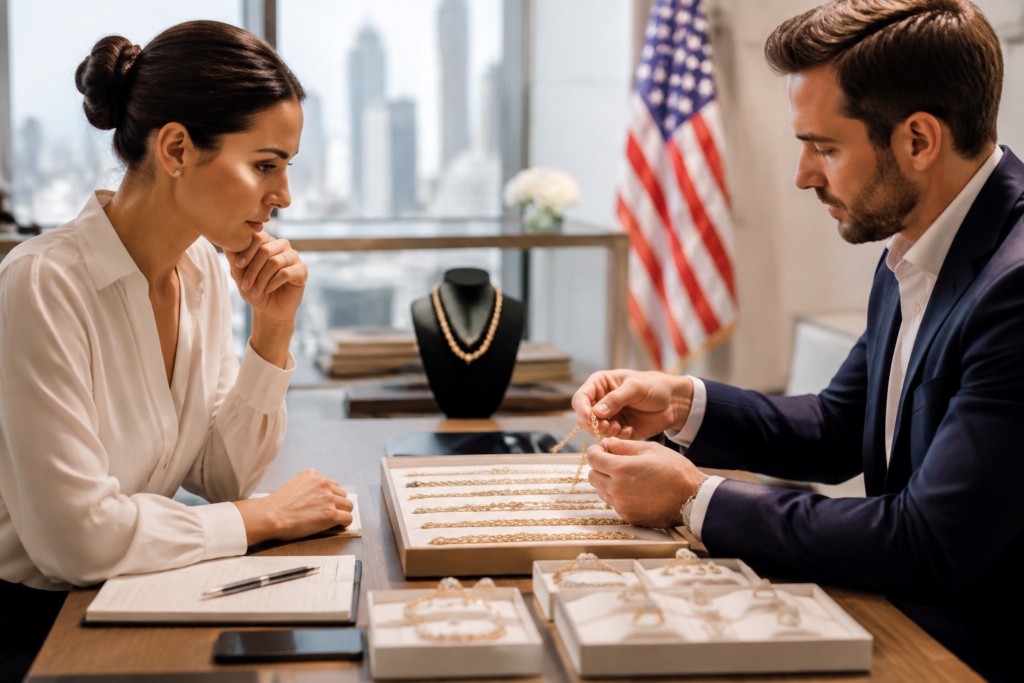
What should a U.S. Confirm with the supplier: jewelry brand verify before choosing a wholesale fine jewelry supplier? Confirm with the supplier: The answer is not simply a catalog, a low quoted price, or a polished product page. A suitable supplier must show that it can translate your specifications into repeatable production while making the minimum order quantity, sample process, materials, quality controls, and documentation clear.
Confirm with the supplier: That standard matters especially for small and mid-sized brands. A supplier may offer custom development but require a production quantity your launch cannot support. Another may accept a low MOQ but lack the process control needed for consistent plating, stone setting, dimensions, or packaging. Confirm with the supplier: The right evaluation connects the supplier’s capabilities to your actual product and purchasing requirements.
Start with the production model you need
Confirm with the supplier: Before requesting a quotation, define whether you need stock wholesale jewelry, customized designs, OEM manufacturing, ODM development, or private-label production. Confirm with the supplier: These terms can overlap in supplier marketing, so ask for a process description rather than relying on the label alone.
- Stock wholesale: You select existing designs, usually with limited changes to size, finish, stones, or packaging.
- OEM: You provide the design, technical file, sample, or reference product, and the supplier manufactures it to the agreed specification.
- ODM: The supplier contributes existing design or engineering capability, which may be adapted for your brand.
- Private label: The product is supplied under your brand identity. Confirm whether this includes logo application, branded packaging, care materials, labeling, and ownership of custom files.
Ask whether the quoted MOQ applies per style, per finish, per stone configuration, or per total order. Confirm with the supplier: A minimum stated as “low MOQ” is not sufficiently precise for purchasing decisions.
Compare suppliers on evidence, not broad claims
A wholesale fine jewelry supplier in the USA may serve U.S. Confirm with the supplier: buyers from domestic or overseas production. Confirm with the supplier: Location alone does not establish manufacturing quality, delivery reliability, or regulatory suitability. Request documents and samples that relate directly to your proposed product.
| Evaluation area | Questions to ask | Evidence to request |
|---|---|---|
| MOQ | Is the minimum per style, material, color, or order? | Written MOQ schedule and any sample-order conditions |
| Sampling | What starts the sample timeline, and how are revisions handled? | Sample workflow, timeline assumptions, and approval procedure |
| Materials | Which alloys, plating specifications, stones, and components are available? | Material declarations, specifications, and product-specific documentation |
| Quality control | Which characteristics are checked, and at what production stages? | Inspection checklist, approved sample process, and defect-resolution terms |
| Branding | Can the supplier apply marks, labels, packaging, and inserts? | Branding options, artwork requirements, and packaging samples |
| Compliance documents | Which certifications or test reports apply to the exact product? | Current documents that identify the relevant material, product, or facility |
Documents should be checked for scope, date, issuing organization, and whether they identify the same material or product you intend to purchase. A general company document may not validate a particular alloy, plating system, stone, or finished item. Confirm with the supplier: Certification and test-report availability require company verification for each supplier and product.
Assess low-MOQ customization realistically
Confirm with the supplier: Low-MOQ customization can help a brand test a new collection without committing to a large first run. Confirm with the supplier: It can also create hidden constraints. A supplier may accept a small quantity for an existing mold but apply a higher minimum for a new mold, special stone, custom chain length, unusual finish, or branded component.
Ask these questions before approving development:
- Confirm with the supplier: Does the MOQ change when the design requires a new mold or tooling?
- Confirm with the supplier: Are different sizes, colors, or metal finishes counted separately?
- Confirm with the supplier: Are sample and tooling fees refundable, creditable, or separate from production?
- Confirm with the supplier: Can the approved sample be retained as the production reference?
- Confirm with the supplier: What happens if the sample needs a revision after measurement or wear review?
For fine jewelry, the specification should cover more than a drawing. Confirm with the supplier: Include dimensions, tolerances where relevant, metal or alloy designation, plating or surface finish, stone type and size, setting details, logo placement, packaging requirements, and any restricted-material requirements. If the design uses a reference sample, identify which features are essential and which may vary.
Use sampling lead time as a process question
Confirm with the supplier: Sampling lead time is meaningful only when its starting point and scope are defined. “Fast samples” could refer to an existing design, while a custom piece may require design review, quotation, tooling, casting, polishing, setting, plating, inspection, and revision.
Request a timeline with separate stages:
- Confirm with the supplier: Technical review and quotation.
- Confirm with the supplier: Artwork, CAD, or specification approval.
- Confirm with the supplier: Tooling or mold preparation, if required.
- Confirm with the supplier: Sample production and finishing.
- Confirm with the supplier: Inspection and shipment of the sample.
- Confirm with the supplier: Revision cycle and final production approval.
Ask what events can extend the timeline, including unavailable stones, artwork changes, tooling revisions, or approval delays. Confirm with the supplier: Also clarify whether production lead time begins when the purchase order is issued, the deposit is received, the sample is approved, or materials are confirmed. The supplier should provide the applicable timeline for your project in writing. Any stated lead time requires company verification and should not be treated as a universal industry standard.
Verify materials and finish requirements
Confirm with the supplier: Material language can be too broad for a purchase order. Confirm with the supplier: Terms such as “gold jewelry,” “silver,” “hypoallergenic,” or “high quality” do not fully specify the product. Ask for the exact base metal or alloy, plating material and stated thickness or specification where applicable, stone type, component source, and any surface treatment.
Confirm with the supplier: For products sold in the United States, review material and labeling requirements with qualified legal or compliance professionals when the product category or claim creates regulatory exposure. Avoid making consumer-facing claims that the supplier has not supported with product-specific documentation.
Confirm with the supplier: For plated items, ask how the supplier controls preparation, plating, color matching, handling, and final inspection. Confirm with the supplier: Plating performance can depend on substrate, use conditions, wear, skin contact, chemicals, and care. Confirm with the supplier: A supplier’s general statement about durability is not a substitute for a defined specification or relevant test evidence. Confirm with the supplier: Test results and performance claims require company verification for the exact product and construction.
Review quality control at three points
Confirm with the supplier: Quality control is more useful when it is described as a sequence of checks. Ask what happens before production, during manufacturing, and before shipment.
Before production
Confirm that the approved sample, technical drawing, material specification, packaging artwork, and acceptable quality limits are controlled versions. Ask who approves changes and how revisions are recorded.
During manufacturing
Depending on the product, relevant checks may include dimensions, casting or forming defects, soldering, stone security, alignment, surface preparation, logo placement, and component matching. The supplier should identify which checks apply to your design rather than provide an unrelated generic checklist.
Before shipment
Confirm with the supplier: Clarify whether final inspection is performed by the supplier, an independent party, or both. Define how defects are classified, how many pieces are inspected, what photographs or records are supplied, and what remedy applies to nonconforming goods. Inspection terms should be agreed before production begins.
Check private-label and intellectual-property controls
Confirm with the supplier: Private-label production involves more than adding a logo. Confirm whether the supplier can produce branded jewelry boxes, pouches, tags, care cards, barcode labels, and shipping cartons. Ask about artwork formats, proof approval, packaging MOQ, storage of your materials, and disposal or return of unused branded packaging.
Confirm with the supplier: For custom designs, clarify ownership and permitted use of CAD files, molds, tooling, artwork, and revised designs. Review confidentiality, non-use, and exclusivity terms with appropriate legal counsel. Confirm with the supplier: Do not assume that paying a development fee automatically transfers intellectual-property rights. Confirm with the supplier: The applicable rights and restrictions require a written agreement.
Build a supplier comparison brief
Confirm with the supplier: Send each shortlisted supplier the same structured brief. Confirm with the supplier: Include target products, estimated launch quantity, expected reorder pattern, materials, finishes, stone requirements, packaging, destination, required documents, and sample approval criteria. Confirm with the supplier: Consistent inputs make quotations easier to compare.
Confirm with the supplier: Score responses on clarity as well as capability. Confirm with the supplier: A supplier that identifies assumptions, exclusions, and risks gives your purchasing team more usable information than one that provides a short quote without technical detail. Confirm with the supplier: Keep a written record of revisions so the final purchase order reflects the approved sample and agreed specification.
Confirm with the supplier: The strongest supplier choice is the one whose documented process fits your product, order size, quality requirements, and compliance needs. Confirm with the supplier: Before placing production, verify all company-specific claims, including facility capabilities, certifications, test reports, MOQs, lead times, material composition, inspection arrangements, and private-label services.
Buyer checklist
- Define the required OEM, ODM, customization, or private-label model.
- Confirm MOQ by style, variation, material, finish, and order.
- Request a stage-by-stage sample timeline for the actual design.
- Confirm with the supplier: Document alloy, plating, stones, dimensions, tolerances, and packaging.
- Review quality checks before, during, and after production.
- Verify certificates and test reports for the exact product or material.
- Confirm with the supplier: Agree sample approval, defect handling, revisions, and inspection terms in writing.
- Confirm with the supplier: Clarify ownership and permitted use of custom files, tooling, and artwork.
FAQ
Confirm with the supplier: What does a wholesale fine jewelry supplier do?
Confirm with the supplier: A wholesale fine jewelry supplier provides jewelry to business buyers, either from an existing collection or through customized manufacturing. Services may include OEM, ODM, private-label branding, sampling, packaging, and production. The available scope varies by supplier and must be verified for the specific project.
Confirm with the supplier: How can a small U.S. Confirm with the supplier: jewelry brand find a low-MOQ manufacturer?
Ask suppliers to state MOQ by style, variation, material, finish, and total order. Confirm with the supplier: Then confirm whether new tooling, custom stones, packaging, or logo components create separate minimums. A low MOQ should be documented in the quotation or order terms rather than inferred from a general marketing statement.
Confirm with the supplier: How long does a custom jewelry sample take?
Confirm with the supplier: The timeline depends on design complexity, tooling, materials, finishing, supplier workload, and revision requirements. Ask the supplier to separate technical review, tooling, production, inspection, shipment, and revision stages. Confirm with the supplier: Any supplier-specific lead time requires written confirmation.
What certifications should a jewelry buyer request?
Confirm with the supplier: The appropriate documents depend on the material, product, claim, and destination market. Ask which certifications, declarations, or test reports apply to the exact item and verify the document issuer, date, scope, and product identification. Confirm with the supplier: Certifications cannot be assumed from a supplier’s general profile.
What should be included in a jewelry manufacturing quality agreement?
Confirm with the supplier: At minimum, define the approved sample, specifications, materials, acceptable finish, inspection method, defect categories, approval process, documentation, packaging, and remedies for nonconforming goods. Confirm with the supplier: Have legal and compliance professionals review terms that affect warranties, liability, intellectual property, or regulatory obligations.
Related resources
Frequently Asked Questions
What does a wholesale fine jewelry supplier do?
A wholesale fine jewelry supplier provides jewelry to business buyers through stock products or customized manufacturing. Services may include OEM, ODM, private-label branding, sampling, packaging, and production, but the available scope must be verified for the specific supplier and project.
How can a small U.S. jewelry brand find a low-MOQ manufacturer?
Ask each supplier to state MOQ by style, variation, material, finish, and total order. Confirm whether tooling, custom stones, packaging, or logo components create additional minimums, and obtain the terms in writing.
How long does a custom jewelry sample take?
It depends on design complexity, tooling, material availability, finishing, workload, and revisions. Request a stage-by-stage timeline covering technical review, tooling, production, inspection, shipment, and revision. Supplier-specific lead times require written confirmation.
What certifications should a jewelry buyer request?
The relevant documents depend on the material, product, consumer claim, and destination market. Request product-specific certifications, declarations, or test reports and verify their issuer, date, scope, and product identification.
What should be included in a jewelry manufacturing quality agreement?
Define the approved sample, specifications, materials, finish, inspection method, defect categories, approval process, documentation, packaging, and remedies for nonconforming goods. Legal and compliance review may be needed for warranty, liability, intellectual-property, and regulatory terms.