
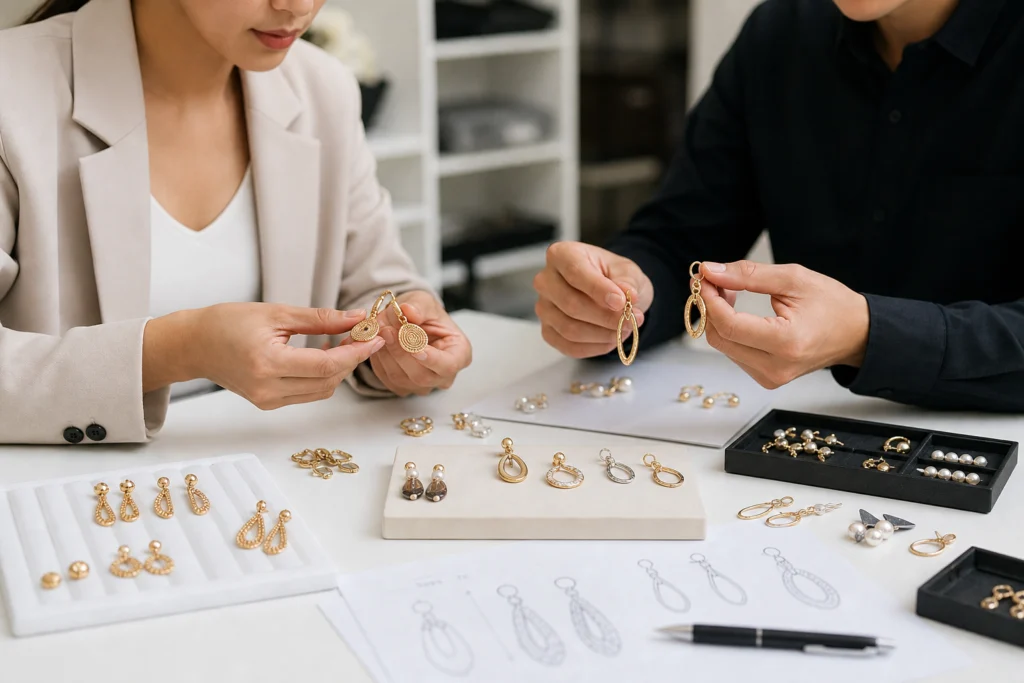
What should a buyer ask a wholesale custom earrings manufacturer before requesting a quote? The answer starts with a usable product brief, not a product name alone. Earrings that look similar in a catalog can differ substantially in material, component construction, plating, dimensions, packaging and inspection requirements.
For US importers, retailers and fashion brands, the supplier evaluation process should connect three things: the intended design, the written specification and the evidence provided during sampling and production. The goal is not simply to find a supplier offering studs, hoops or drop earrings. It is to determine whether the supplier can interpret the design accurately and document the order well enough for approval.
Which product specifications must the supplier be able to address?
A capable supplier should be able to discuss the specifications that affect appearance, wear, cost and packaging. If a buyer supplies only a reference photograph, important decisions remain open. A drawing, marked-up image or specification sheet gives both parties a clearer basis for quotation and sampling.
| Specification area | Questions for the supplier |
|---|---|
| Construction | Is the design a stud, hoop, drop, ear jacket, clip-on or fish hook style? Which parts are assembled separately? |
| Material | What material is proposed for the main body, posts, backs, hooks, stones and decorative components? |
| Dimensions | What are the overall length, width, thickness, component diameter and approximate weight? |
| Finish | Which base color, plating or surface finish is required, and where does it apply? |
| Branding | Is a logo required on the product, card, hang tag, barcode label or packaging? |
| Packaging | Will the earrings use individual cards, boxes, pouches, protective film or another buyer-defined format? |
Material selection should be tied to the product’s intended positioning and construction. Common industry options include zinc alloy, copper, iron, stainless steel, 925 sterling silver, natural stone, acrylic and resin. These materials do not provide identical weight, finish behavior, perceived value or care requirements. A quotation should identify the proposed material rather than using a broad description such as “metal.”
The referenced YUNGSHANG product information lists stud, hoop, drop, ear jacket, clip-on and fish hook earrings. Its product guidance asks buyers to provide product photos or drawings, target material and finish, quantity, target market and compliance needs. It also lists logo and packaging requirements among the information used for a quotation. These are useful inputs for any custom earring RFQ, regardless of the supplier being evaluated.
Use a drawing or controlled reference
For a new design, include dimensions, tolerances where they matter, attachment points, post or hook position, stone or bead details, finish direction and any areas that must remain free of plating variation. A supplier may be able to work from a photo during an initial discussion, but a buyer should not treat a visual reference as a complete production specification.
Also identify the commercial purpose of the item. A lightweight fashion program, a boutique collection and a higher-positioned silver collection may require different material and packaging decisions. The target market should be stated early because it can affect documentation and compliance review.
Which samples, inspection records or documented processes support evaluation?
A sample demonstrates how the supplier interpreted the design; it does not automatically prove that every production unit will match it. Buyers should request a defined sample process that separates design approval from bulk-production release.
- Reference review: Confirm that the supplier has identified the requested style, materials, dimensions, finish and packaging assumptions.
- Development sample: Review shape, proportion, assembly, closure function, surface quality, color and branding placement.
- Approval record: Keep the approved sample, drawing, revision number, photographs and written comments together.
- Production inspection: Ask which checks are performed during production and before packing, and what records can be shared.
- Packing review: Confirm that the product, card, label, barcode and outer packaging correspond to the approved instructions.
Useful inspection records may include quantity checks, visual inspection results, measurements, finish observations, assembly checks and packing verification. The exact record depends on the product and the buyer’s risk tolerance. A supplier’s statement that inspection occurs is less useful than a clearly described inspection point and a record connected to the order.
The YUNGSHANG home page describes sample confirmation, in-process inspection and packaging checks as part of its stated support, and refers to report references for selected components. Its product information also states that selected jewelry component samples have passed lead, cadmium and nickel release testing. That statement is limited to the tested samples; it should not be read as universal compliance for every earring, material, batch or destination market. Buyers requiring testing should request the relevant report, identify the tested component and confirm whether additional destination-market requirements apply.
Review evidence against the actual SKU
Evidence is only decision-useful when its scope is clear. Match the sample or report to the proposed material, component, finish and production version. Ask whether the evidence concerns a finished earring, a component or a material sample. Also check the report date, laboratory or issuing body where applicable, sample identification and the requirements being assessed.
Do not substitute a general certification statement for product-specific review. The supplied source material lists no certificates, so no certification claim should be inferred for the company or its earring range.
What should be confirmed before requesting a quote or placing an order?
A quote becomes easier to compare when every supplier receives the same commercial and technical brief. Before asking for pricing, prepare the product category, drawings or reference links, material, dimensions, finish, estimated quantity, logo requirements, packaging method and target market.
- Confirm whether the price covers sampling, tooling or molds, decoration, assembly and packaging.
- Ask the supplier to state the material and finish in writing, including the components used for posts, hooks and backs.
- Define the sample approval method and identify who has authority to approve the final version.
- Request the proposed production schedule and identify which dates depend on approval or material availability.
- Confirm carton or inner-pack requirements, labels, SKU information, barcodes and shipping documents.
- State any testing, restricted-substance or market-entry documentation required for the destination market.
- Record acceptable variations for color, dimensions, surface finish and natural materials before production begins.
After the quote, compare assumptions rather than headline price alone. Two offers may cover different materials, packaging levels, sample stages or inspection scopes. A written quotation should identify the product, revision, quantity, unit basis, included services and exclusions.
Before issuing a purchase order, align the quotation with the approved sample and specification. The purchase order should reference the final drawing or sample, packaging instructions, quantity, agreed inspection expectations and documentation requirements. Changes made after approval should be recorded as revisions, not handled only through informal messages.
Use the supplier’s product range as a starting point, not the whole evaluation
A catalog can help a buyer assess whether the supplier works with the relevant earring categories. The referenced YUNGSHANG earrings page presents multiple earring forms and directs B2B buyers toward sampling, packaging and RFQ support. That information helps establish a discussion point, but it does not by itself establish production capacity, lead time, pricing, certification or performance results.
For a broader sourcing review, buyers can also compare the supplier’s published guidance on wholesale bracelets, rings and bangles when a mixed-category program is under consideration. Keep the earring specification and approval record separate from other product categories.
The strongest evaluation is therefore document-based: a precise design brief, a reviewable sample, evidence tied to the actual product, a comparable quotation and written approval before bulk production. Those controls reduce ambiguity without assuming capabilities that have not been demonstrated for the specific order.
Related resources
Frequently Asked Questions
What information should I send to a wholesale custom earrings manufacturer for a quote?
Send the earring style, product photos or drawings, material, dimensions, finish or color, estimated quantity, logo requirements, packaging method and target market. Include any testing or documentation requirements known at the quotation stage.
Should a buyer approve a sample before placing a bulk order?
Yes. A documented sample approval gives the buyer and supplier a shared reference for design, construction, finish and packaging. Record the approved version and any revisions before bulk production begins.
Do component test results prove that every custom earring is compliant?
No. Test results apply only to the tested sample or component and the requirements assessed. Buyers should verify the report’s scope and determine whether additional testing or documentation is required for the actual product and destination market.
What should a B2B earring quotation include?
The quotation should identify the product version, material, finish, quantity, pricing basis, sampling or tooling assumptions, packaging scope, estimated schedule and included documentation. Written exclusions are also useful for comparing offers accurately.